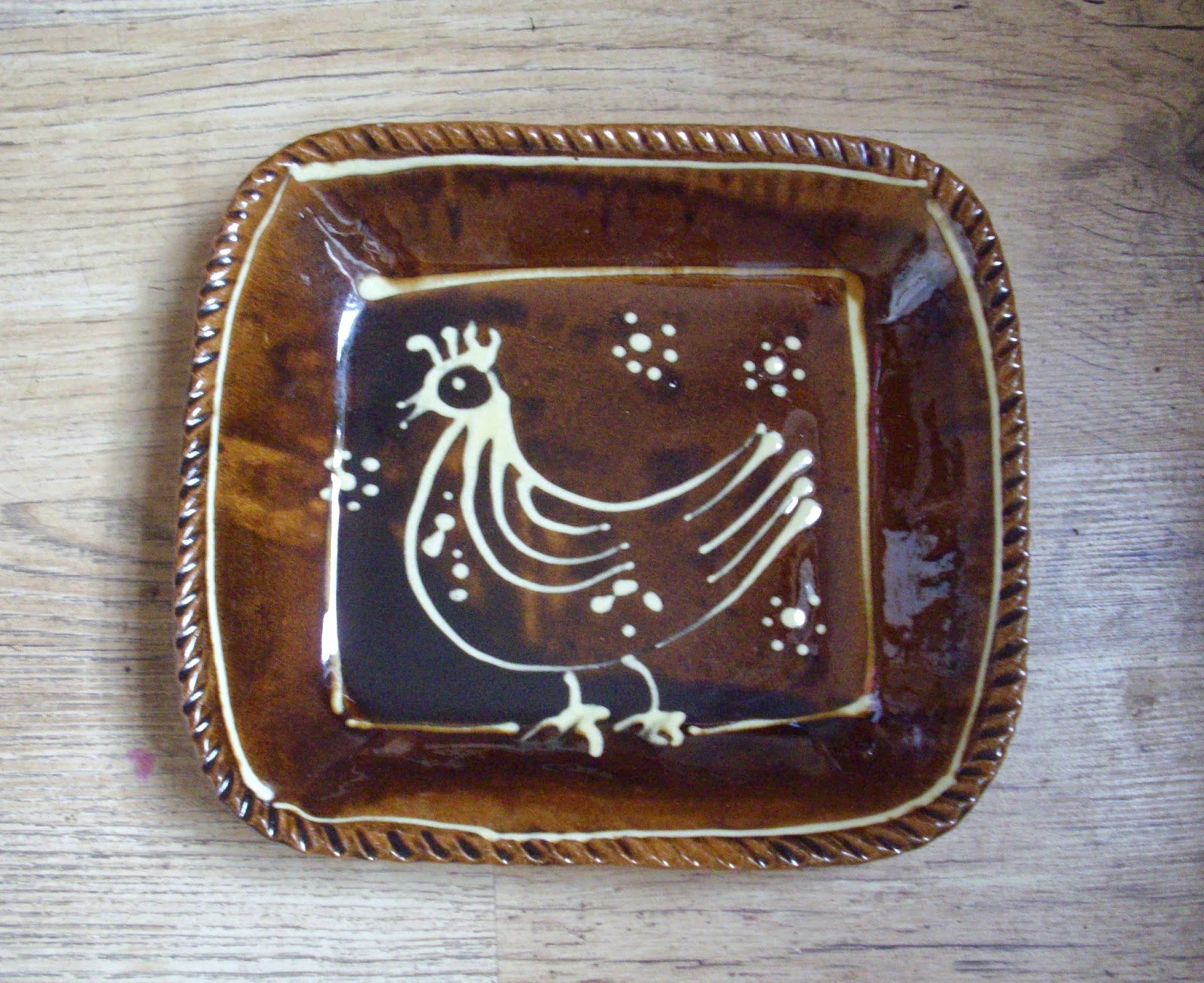
The idea of this blog is to share ideas for using hand-made pots to serve good food.

Eating with friends and family is one of life’s greatest pleasures. I hope to show how the warmth and character of hand made ceramics can really enhance the pleasure of cooking, serving and eating food.

This blog will include pots from other potters as well as my own and recipes for the food which I enjoy, hoping that you will like it too.

Sunday, 13 May 2012


NEW SERVING DISH


It has taken me a while to get inspired to post as I have been busy getting going again after my trip to Japan.  Yesterday I unpacked the kiln and was pleased with the new design of serving dish I had made.  The top is a slab of clay, rolled out using my slab roller, with a cloth texture and stamped decoration on the edges.  I like the colour contrast and the way the textures work together.


Today I put it to the test, to make a good looking lunch platter for an Italian journalist who was coming to lunch.

With some soup and home-made bread, a few left over bits and pieces I had in the fridge turned into a respectable kind of lunch.

The key elements were really the serving dish itself and some lovely fresh small-leaf watercress which provided the backdrop to the other ingredients.


The serving dish has a thrown foot ring.
The thrown foot ring is pushed into shape when soft and left to firm up before attaching to the slab, when both are leather-hard.
The thrown foot ring seems to support the slab better than feet which I have used before and the dish was less prone to warping.


I feel inspired now to make more of these type of serving dishes - trying some larger ones and maybe other shapes.  Also to use it for some more adventurous ingredients.

Thursday, 19 April 2012

Eating at 'Zero' in Fukuoka, Japan

One of the greatest pleasures about exhibiting at the Gallery Shozando in Fukuoka recently was the chance to eat at the wonderful ‘Zero’ restaurant next door.  Zero is run by an exciting young chef, Ryota Takenouchi and his wife, Rie. They serve Japanese food, based around seasonal ingredients.  He grows some of the vegetables himself and has been busy planting for the coming season.


At lunchtime they serve a ‘Zero Platter’ which changes monthly, according to what is in season. The food is served on a hand-made slab-dish made by a potter in Shigaraki. The dish, although it was not specially commissioned for the ‘Zero Platter’ is the ideal backdrop for this combination of food.  Mr. Takenouchi told me that when he is putting together a plate of food like this, he approaches it rather like a painter trying to work out a satisfying combination of shapes and colours on the background he has chosen. 


The platter is served with a bowl of clear soup and a bowl of salad on the side.  Japanese tea is served before and during the meal, and a cup of coffee afterwards.

The combination of pots and food worked perfectly and, of course, it was delicious.  The slightly rough texture and earthy tones of the pots contrasted with the vibrant colours and soft textures of the food.  The bamboo chopsticks invited you to select dainty morsels of the food and try combinations of the delicate flavours.  It is the kind of food which leaves you feeling completely satisfied without feeling that you have over-indulged.  

Talking with chef, Takenouchi, about how he selects the pots for his restaurant was fascinating.  He says that the food comes first, but without an appropriate pot for a certain dish, he will not serve it.  He sometimes gets inspiration from pots to prepare certain foods in a particular way.  He believes that presentation of the food contributes about 30 per cent of the overall enjoyment of a dish.

He has a very good relationship with the gallery, Shozando, next door.  They share many of their customers and he sources many of his pots through them as well.  Ideally, he would like to make the pots as well, in the tradition of Kitaoji Rosanjin, but with a restaurant to run and vegetables to grow, he seems to have plenty to do at the moment.  The day I interviewed him, he had just finished making 50 lunch boxes for people who were cherry blossom viewing.


These are my pots on show at Shozando gallery, with pots by Ruthanne Tudball on the shelves behind.


These are pots by Masahiro Kumagae, beautifully displayed with glassware at Shozando gallery.  The gallery owner, Rie Arimitsu, has a great talent for displaying pots in a way which invites you to use them - and tempts you to buy more than one item, as they look so good together.   My trip to Japan has left me with a wealth of inspiration for pots, food and ideas about how to run a gallery - food for thought for a long time to come.

Saturday, 14 April 2012

Cherry blossoms in Japan


It was wonderful to be in Japan for the cherry blossoms, though we had to wait until the last week of our stay, as this spring has been rather cold and they are flowering late.  People make special trips to stroll under the trees.  In the parks, mats are laid out under the trees for people to have picnics and drink beer and sake whilst viewing the blossoms.  Our favourite restaurant made fifty lunch-boxes last Saturday for people to enjoy whilst flower viewing.  It is in all the newspapers and on TV so people know which region is in full bloom.


The gallery Shozando, where I was exhibiting in Fukuoka, had a special cherry-blossom display and customers would bring in sticky rice cakes like this one, wrapped in an edible cherry leaf, for us to enjoy.  When we ate in the neighbouring restaurant, Zero, there was a dish of white rice noodles garnished with a single cherry flower as part of a delicious evening banquet.

This awareness and celebration of the seasons is reflected in the food and the pots in which it is served. Seasonality really means something in Japan, where the foods of each season are anticipated and enjoyed as they come into season.

Another seasonal speciality which we enjoyed on several occasions was take-no-ko - bamboo shoots - and we even dug some up ourselves, which was a first for me.  They were delicious cooked with rice or simmered in a broth with shiitake and other vegetables. 


The countryside was splashed with the vibrant yellow of oil-seed rape flowers.  They are also eaten served, lightly steamed, whilst still in bud, as a seasonal speciality.


Here they were served with a piece of octopus and a deliciously tangy sauce made with white miso, yuzu (a citrus fruit, similar to lime, but with a distinctive flavour of its own) and mustard.  The combination of colours, textures and tastes in this dish was heavenly!

There were so many wonderful meals and pots.  I will be posting again soon as I want to share more of these inspiring experiences, while they are still fresh in my mind.

Monday, 12 March 2012

Casserole Photo


This is a photo of one of my small casseroles.  I am very fond of this green copper glaze, especially when it gets quite hot in the kiln, as it takes on a lustrous quality.  It is hard to photograph, though, as it is so shiny.

The decoration is done with finger wipes and a comb made from a rubber rib, cut with rounded points.

I am going to Japan this week.  I will be exhibiting at Gallery Roola in Nagoya from March 13th to 25th with Peter Seabridge who lives in Japan and Ruthanne Tudball, an american potter from the UK.  We are also exhibiting in Fukuoka at Gallery Shozando, from April 1st to 7th.

I am sure it will be a very inspiring trip, both from the point of view of pots and food.  I am planning to take plenty of photos for the blog.  So watch this space!  I am not taking my laptop, so probably won't post until after April 9th when I return to Devon.

Sunday, 26 February 2012

Venison Casserole

When I was thinking about starting this blog, I was wondering what to call it and nearly went for the name, CASSEROLE, as it is both a pot and a kind of food or cooking method.  In the end, I thought that 'pots and food' was simpler and might catch more interest.
  I have been making some casseroles of the pot variety, which I am quite pleased with and have been trying out some recipes to cook in them.  I like using game, such as venison, as I like the idea that the animals I eat have had the chance to roam free. This is my favourite recipe to date.   


 Venison Casserole 
This is a hearty meat casserole which also includes a fair amount of vegetables.  It needs a long, slow cook, so not a good recipe if you are in a hurry.  I have made this with chestnuts instead of the butternut squash, which was delicious, but chestnuts are not always easy to find.  The quantities given are really just a guide and can be adjusted to what you have or what you like.  The prunes add a fruity sweetness which complements the meat very well.  You could omit them and serve with a redcurrant jelly on the side instead.

INGREDIENTS - Serves 4
500 g / 1 lb diced venison
200 g / 8oz shallots
100 g / 4oz button mushrooms
200 g / 8oz butternut squash
1or 2 sticks of celery
100 g / 4oz prunes
thyme - a couple of sprigs
or 1 tsp dried thyme
bay leaf
1 large glass red wine
beef stock or water
oil - about 2 tablespoons
flour
salt and pepper
  • METHOD

  • Pre-heat the oven to 200°C/400°F/ Gas 6
  • Dice the venison into pieces about 2-3 cms sq and roll in seasoned flour
  • Heat the oil in a heavy bottomed pan and brown the meat in batches
  • Put the browned meat on one side and fry the shallots (peeled and whole, or cut in half if they are large) in the same pan, until they begin to colour.
  • Add the finely chopped celery and the button mushrooms and fry for a couple of minutes.
  • Add the meat back into the pan with the other ingredients and add the red wine. Let it simmer a little and then add the butternut squash, peeled and diced, the herbs and the prunes.
  • Add enough beef stock or water to cover. 
  • Put in an ovenproof casserole and place in the pre-heated oven.
  • Cook at 200°C for half an hour and then turn the heat down to 180°C /350°F Gas 4 and cook for a further one and a half hours or more.  Check to see if the casserole needs more liquid every half hour or so.  The sauce should thicken up into a delicious gravy. Taste to see if more seasoning is needed and add salt and pepper as required.
  • Serve with mashed potato, polenta or anything which will absorb the gravy. 


I have been having trouble getting a decent photo of the casseroles (as in pots) which I have made, as they are very reflective, but I will have another go and post a photo soon.

Saturday, 18 February 2012

Butternut Squash and Carrot Soup

This is the recipe for the soup which I posted about in my search for the perfect soup bowl.


Butternut squash and carrot soup
This soup is the ideal autumn and winter comfort food, with its sweetness and creamy texture.  You could give it extra warmth by the addition of spices, such as roasted and ground cumin and half a fresh chilli added when the onions are frying. 
It can be also made richer by a spoonful of cream stirred in at the end.

INGREDIENTS – Serves 6
Half a medium sized butternut squash
3 – 4 carrots
I medium sized potato
I onion
I stick of celery
2 tablespoons of olive oil
500 ml Vegetable stock
Salt and pepper
Cream and parsley to garnish


METHOD
  • Roughly chop the onion. 
  • Heat the olive oil in a heavy bottomed saucepan and add the chopped onion.  Fry over a gentle heat until lightly browned.
  • Meanwhile chop the celery, peel and chop the carrots, potato and butternut squash into small chunks.  
  • Add the chopped vegetables and stock, plus enough water to cover the vegetables comfortably.
  • Season with a generous pinch of salt and freshly ground pepper.
  • Bring to the boil and then simmer, covered, for about 30 minutes until the vegetables are soft. Liquidize the soup to a smooth consistency and serve with a swirl of cream and a sprinkling of finely chopped parsley.


I hope you enjoy this soup as much as I do.  

Monday, 6 February 2012

A Meal with Sandy Brown


Yesterday evening I went to have a meal with Sandy Brown at her home in Appledore.  The meal was prepared by Shun, a young Japanese potter who had been working with me last December and is now helping Sandy.  My present apprentice, Curtis, also lent a hand.  Shun had cooked some delicious 'takekomi-gohan' - rice cooked with small pieces of chicken and vegetables flavoured with soy sauce - and then made tempura of vegetables and prawns.

 The food was served on pots made by Sandy.  The overall feeling of the pots and food was one of generosity.  The pots are generous in size, accommodating generous amounts of food and giving the food plenty of room, so that it is easy to appreciate both the food and the pot it is served in.


The tea cups shown here were used for a dipping sauce and the tempura was laid on the large slab platter as it was cooked.


Sandy's pots have vitality and strength, as well as a feeling of playfulness and joy, which make eating a pleasure and give a sense of occasion to the simplest of dishes.  The meal was a great example of how much hand-made pots can contribute to the enjoyment of food.  They also look great on the shelf when not in use.