The idea of this blog is to share ideas for using hand-made pots to serve good food.

Eating with friends and family is one of life’s greatest pleasures. I hope to show how the warmth and character of hand made ceramics can really enhance the pleasure of cooking, serving and eating food.

This blog will include pots from other potters as well as my own and recipes for the food which I enjoy, hoping that you will like it too.

Sunday, 1 March 2015

Penny's Calendar Recipe for March

Buttermilk Pudding and Orange Compote 

Buttermilk Pudding

Ingredients 
serves 4

2 x 2g leaves gelatine
250ml double cream
115g caster sugar
100ml full-fat milk
100ml buttermilk (use yoghurt if you can’t get buttermilk)
vegetable oil, to grease
This is really simple. If you can’t get buttermilk, then yoghurt is a good substitute. The sour taste really freshens the pudding up. This is great with any seasonal fruits.

1. Soak the gelatine leaves in cold water. Pour the cream into a pan, add the sugar and heat gently, stirring, until the sugar has dissolved. Bring just to a simmer, and then take off the heat.
2. Squeeze out the gelatine and then stir it into the warm cream mixture to dissolve. Pour through a sieve into a clean bowl and stir in the milk and buttermilk. Taste for sweetness and add more sugar if necessary.
3. Grease the inside of 4 small ramekins, if you plan to turn them out, and divide the mixture between them. Cool and then refrigerate for at least 4 hours or overnight.
4. To turn out, put the dishes briefly in boiling water and then invert on to plates or shallow bowls

Orange Compote
2 oranges (use blood oranges if available)
1 tbsp marmalade
1. Peel the oranges and cut the segments out with a sharp knife.
2. Place the orange segments in a sieve and let the juices drain off for about 5 minutes.
3. Place the marmalade in a small saucepan, gently heat. Add the orange juice to let the marmalade down.
Remove the saucepan from the heat once the marmalade is melted.

4. Gently fold the marmalade coulis in to the orange segments, do not mix too much as you do not want to break them.

Wednesday, 18 February 2015

Penny's Calendar Recipe for February

Orecchiette and Broccoli Pasta


1 200g orecchiette
2 4 tbsp olive oil
3 6 anchovy fillets in oil, chopped (optional)
4 4 fat garlic cloves, thinly sliced
5 1 red chilli, thinly sliced
6 zest 1 lemon, plus juice ½
7 50g fresh breadcrumbs
8 200g purple sprouting broccoli

Cook the orecchiette following pack instructions. 
Meanwhile, heat 3 tbsp of the olive oil (and 1 tbsp of the oil from the anchovies if using )in a frying pan.
 Add the garlic and chilli, and sizzle for 3-4 mins until the garlic is just starting to turn golden.
I Add the anchovies and lemon juice, and cook for 1-2 mins more until the anchovies melt into the sauce. 
Put the remaining olive oil, breadcrumbs and lemon zest in another frying pan, stir together and cook until crisp.
When the pasta has 4-5 mins to go, add the broccoli to the pan.
When cooked, drain, reserving a cup of the pasta water, then add to the frying pan with the garlic and anchovies.


Stir and cook over a low heat for a further 2 mins, adding a splash of pasta water if it looks dry. Season, then serve in pasta bowls with the lemony crumbs sprinkled over.


Wednesday, 24 September 2014

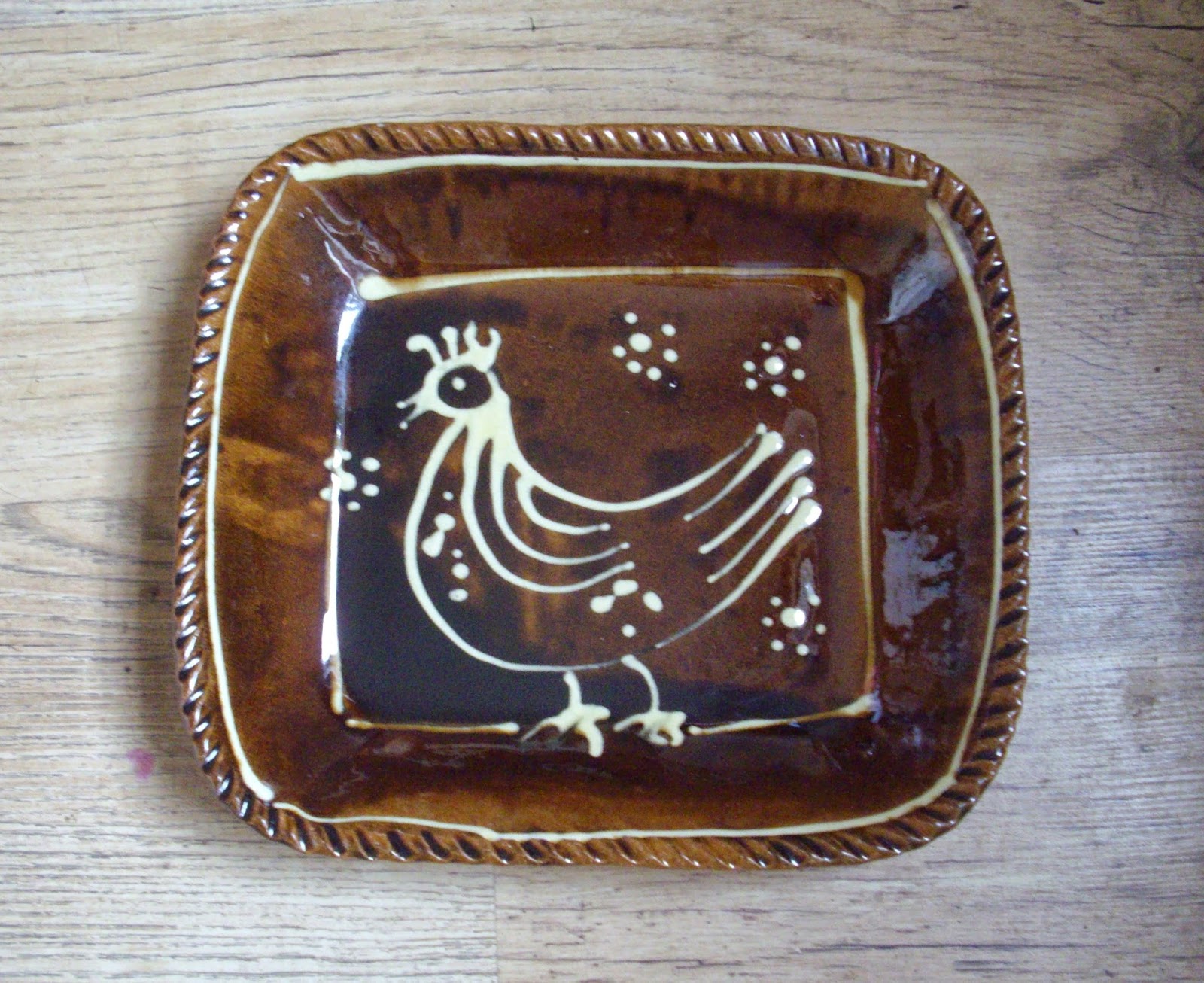
Oven dish by Geoff Fuller


I was exhibiting at the Wardlow Mires Festival of Pottery and Food in Derbyshire last weekend, I couldn’t resist this lovely oven dish made by Geoff, who is one of the organisers of the festival. 

His slip-trailing decoration gets simpler and more lively as the years go by. 

I used it as soon as I got home for a take-away lamb biryani with some veg. It looked wonderful. 

Wednesday, 17 September 2014

POTS AND FOOD CALENDAR 2015


I am excited to be able to announce that my new Pots and Food Calendar came out last week, it was much admired at the Wardlow Mires Pots and Food event at the weekend. 

This year I have worked in collaboration with Ben Bulger, head chef at The Magdalen Chapter hotel in Exeter, to produce the calendar.  He devised the recipes and cooked them in my kitchen where we plated them on my pots for Suzy Bennett to photograph. The photo-shoot was great fun and an exhausting day’s work. I was left with lots of delicious food - and of course piles of washing up!  

I like Ben’s food very much and his seasonal approach to cooking, influenced by time working at Riverford Field Kitchen, is ideal for the calendar.  As before, the recipes for the dishes are included on the calendar.  I hope you will enjoy trying the recipes - which of course taste better on hand-made pots.


The calendar, priced at £10, and you can also buy it from The Studio in Moretonhampstead, or call me and I can post direct.


Monday, 28 April 2014

Pots from Japan

I returned from Japan just over a month ago and have been enjoying some of the pots which I bought when I was there.

I bought these two bowls by Yoshihisa Okamoto in Mashiko.  I like his work very much.  The decoration is so simple and they are lovely to use for things like a small salad.


I was given this beautiful bowl by Ken Matsuzaki who was also very generous with his time and knowledge when I visited his workshop.  He took me to visit his brother who makes lacquerware.  He gave me a chunky little sake cup in lacquerware. He explained the advantage over a ceramic sake cup is that when you get very drunk and drop it, it doesn’t break.  The colour is wonderful and it feels good to hold.  I look forward to getting some sake to try it out.


When I was in Kyushu, I spent some time with Masahiro Kumagae, who exhibited in England last summer.  I like his new work very much.  This is a yunomi (japanese tea cup) with his new glaze.  It is good in the hand and shows his very fluid throwing style.


Now I have to make more pots for food, inspired by all the wonderful meals I had in Japan.

It is always good to experience the respect they have for hand-made pots in cafes and restaurants as well as in people’s homes.  Hand-made pots definitely increase the joy of eating.

Monday, 14 April 2014

Visit to Japan


This is a picture from my exhibition in Shozando Gallery in Fukuoka, Japan.  I was there two years ago and it was wonderful to be back.

I gave a bowl to the chef and his wife at Zero, the restaurant next door to the gallery, where we had two delicious meals.  This is what they did with it!  It was very good and makes me want to give away more pots.


It partly explains why I haven’t been posting on the blog for far too long.  I realize that I can’t travel without my laptop any more. 

This is their famous lunch platter.  Just as good as ever.  A real symphony of colour and taste, beautifully presented.


Wednesday, 11 September 2013

Berries and Jellies


All this good weather has enticed me to spend time exploring the footpaths of Dartmoor, where I live.
Instead of writing posts on this blog!  Now that autumn has arrived I have been enjoying foraging for hedgerow fruits to make jellies, so I can't resist sharing the joy of Jellies.
The rowan trees seem to be especially laden this year so last week I picked rowan berries to make a Rowan Jelly.


It is a beautiful colour and has a delicate, slightly bitter taste.  I like it for breakfast on toast with a bit of soft goats cheese.  It would also be lovely with roast meats.  One recipe I looked at was infused with rosemary, which would be perfect with something like a roast lamb.


At the weekend I discovered blackberry heaven when out walking.  It was a field with conveniently spaced bushes laden with huge blackberries.  Three of us picked enough blackberries in about fifteen minutes to make six pots of delicious Bramble Jelly.


I added some lemon juice and a cooking apple to help the set for both jellies.  The recipe consisted of simply boiling up the fruit (barely covered with water) until soft and then straining the liquid through a bit of muslin.  I left it to drip overnight.  
The liquid is then combined with sugar in the proportion of 1lb of sugar to 1pint of liquid.
It is good to heat the sugar slightly (5 minutes in a low oven) before adding it to the liquid and it is important to stir it over a low heat until the sugar is dissolved, before bringing it up to the boil and simmering until setting point is reached.  It should take around 30 minutes or more.  You can test it by putting a teaspoon full on a saucer which has been chilled in the fridge and see if it begins to wrinkle when pushed.  When it is ready, let it cool slightly and then pour in to sterilised jars.
To sterilise the jars, the easiest way is to wash and dry them, then put them in a medium oven for 5 minutes.

Exercise, fresh air, wonderful scenery and free food.  Dartmoor foraging is highly recommended!